Elon Musk Plans to Spend $119 Billion to Construct the World’s Largest Building, Just Outside Houston
On August 6th 2026, Tesla and SpaceX formally confirmed Terafab, a jointly built semiconductor megafactory in Grimes County, Texas, just north of Houston. On X, Elon Musk called it the largest and most valuable building on Earth by far. The site plans exceed 100 million square feet of manufacturing space, more than five times China’s New Century Global Center and larger than the Pentagon, Apple Park, and Mall of America combined.
The pitch is vertical integration at a scale nobody has attempted. Terafab will house manufacturing, packaging, and testing of advanced logic and memory chips in a single facility, aimed squarely at the bottleneck Elon Musk keeps hitting: there are not enough chips on Earth to build the Optimus robots, Cybercabs, and space-based data centers he has pitched investors. SpaceX describes the plant as designed to bridge the divide between current global chip supply and the compute demand of the future, with a stated production goal of more than 1 terawatt of compute per year optimized for edge inference.
The money framing matters. What is committed now is $16.8 billion for the first phase. The widely quoted $119 billion figure is a multi-phase ceiling SpaceX disclosed in its May 2026 filings, and represents a top-end estimate, not confirmed spend. The legally binding floor is more modest: agreements signed by SpaceX CFO Bret Johnsen commit at least $5 billion in Grimes County by 2030 and at least 1,800 full-time jobs by 2035.
Intel has agreed to contribute but has been vague about the size of its commitment.
Beyond the binding floor, the partners are promising at least 3,000 jobs across Grimes and neighboring Brazos County, with early production as soon as 2027 and mass production targeted for 2028. Texas is sweetening the deal: SpaceX received a $30 million Texas Enterprise Fund grant, and the project qualifies under the state’s Texas Jobs, Energy, Technology, and Innovation program. Elon Musk first floated Terafab in Austin on March 22nd 2026.
Water was the community’s first question, and the answer is unusual. The site sits on Gibbons Creek Reservoir, which previously cooled a coal-fired power plant that closed in 2018. SpaceX has committed to drawing process water from the reservoir rather than local groundwater, a concession clearly aimed at farmers worried about aquifer draw. Local reaction has been split.
A Grimes County meeting on August 5th 2026 drew hundreds of residents objecting to the scale of tax breaks and what they described as a lack of transparency. On the other side, the Texas Governor’s office believed this agreement will strengthen its district, expand opportunities, and better prepare its students for their future. In January 2025, Tesla CEO Elon Musk’s use of hand gestures that critics compared to a fascist salute took on a life of its own on social media.
Critics on social media immediately compared the gesture to a “Sieg Heil”, the victory salute used to excite crowds in Nazi Germany.
A representative for Elon Musk’s so-called Department of Government Efficiency did not immediately respond to a request for comment. Elon Musk reposted content on X to his nearly 215 million followers, including clips of his remarks, but did not responded to the controversy. The salute also generated a frenzy among foreign press. Elon Musk had drawn attention in the past for his mannerisms on stage, including the infamous “dark MAGA jump” during President Donald Trump‘s second rally in Butler, Pennsylvania.
In April 2024, another round of price cut shaved $2,000 off the starting prices of Tesla’s Model Y, Model X and Model S for buyers in the United States. Tesla’s North America branch posted on X about the change to the Model Y, at the same time announcing that the company was ditching its referral program benefits in all markets. Tesla’s Model Y started at $42,990 for the rear-wheel drive base model, $47,990 for the Model Y Long Range, or $51,490 for the Model Y Performance.
The base Model S dropped to $72,990 while the Model S Plaid started at $87,990. The Model X started at $77,990 (base) or $92,990 (Plaid). The changes came during rocky weeks for Tesla which just issued a recall for Cybertrucks over possible issues with the accelerator pedal. Tesla reportedly laid off 10 percent of its employees and a decline in deliveries for the first quarter.
Prices for the locally produced Model 3 and Model Y were cut by around 4-6 percent, while the imported Model S and Model X were reduced by as much as 22 percent.
The Model S and Model X were not produced in China and were sold in the United States through imports. The Model 3 was offered in two trims in China, the Model Y in three, and all of them see a price drop of RMB 14,000. Tesla had a factory in Shanghai that produces the Model 3 and Model Y. The entry-level, rear-wheel-drive Model 3’s starting price was RMB 231,900, down RMB 14,000 from the previous price of RMB 245,900.
The starting price for the dual-motor Model 3 Long Range was RMB 271,900, down RMB 14,000 from RMB 285,900. The entry-level rear-wheel drive Model Y had a starting price of RMB 249,900, a decrease of RMB 14,000 from RMB 263,900. The Model Y Long Range had a starting price of RMB 290,900, down RMB 14,000 from RMB 304,900. The Model Y Performance had a starting price of RMB 354,900, a decrease of RMB 14,000 from RMB 368,900.
In terms of delivery wait times, both variants of the Model 3 had gone from 2-6 weeks to 3-6 weeks, and all three variants of the Model Y have remained unchanged at 2-6 weeks. Both the Model S and Model X were available in China in regular versions and the more expensive and powerful Plaid version. The starting price for the regular Model S was RMB 684,900, a decrease of RMB 124,000 from RMB 808,900.
The Model S Plaid’s starting price was RMB 814,900, down RMB 214,000 from RMB 1,028,900.
The regular Model X started at RMB 724,900, down RMB 174,000 from RMB 898,900. The Model X Plaid’s starting price was RMB 824,900, down RMB 234,000 from RMB 1,058,900. The estimated delivery dates in China for all variants of the Model S and Model X were the third quarter of 2024. Notably, Tesla lowered the prices of the Model Y, Model S, and Model X by $2,000 in the United States, but there were no changes to the Model 3 or Cybertruck.
Tesla delivered 386,810 vehicles globally in the first quarter of 2024, down 20.16 percent from the fourth quarter of 2023. That was the first time since the second quarter of 2020 that Tesla’s global deliveries had seen a year-on-year decline, and well below analysts’ estimated of 449,080 vehicles. Tesla sold 132,420 units in China, its second-largest market after the United States, in the first quarter of 2024, contributing 34.23 percent of global deliveries.
In March 2024, Tesla sold 62,398 vehicles in China, up 107.02 percent from 30,141 in February 2024. Tesla’s Shanghai plant exported 26,666 vehicles in March 2024, down 11.77 percent from 30,224 in February 2024. The first model produced at Tesla’s Shanghai plant was the Model 3, with deliveries beginning in January 2020. Deliveries of the locally produced Model Y started a year later in January 2021.
The Model Y was one of the best-selling models in China, with monthly sales exceeding even many traditional gasoline cars.
And after deliveries of the locally-produced Model Y began, deliveries of the Model 3 drop significantly. For the full year of 2023, the Model Y sold 456,394 units in China, contributing 75.6 percent of Tesla’s full-year sales of 603,664 units in China. The Model 3 sold 147,270 units in China in 2023, contributing 24.4 percent of Tesla’s annual sales in China.
With the rapid development of the electric vehicle (EV) industry in China, both the Model 3 and Model Y were facing an increasing number of competitors. Smartphone giant Xiaomi launched its first EV model, the SU7, on March 28th 2024, the latest in a slew of Model 3 rivals at a lower price. The Model Y was still selling well in China, but the arrival of more and more competition threatened Tesla’s dominance of the crossover segment.
Nio’s sub-brand Onvo, codenamed Alps, launched its first model in 2024. Onvo’s first model would compete directly with the Model Y, with bill of materials (BOM) costs about 10 percent cheaper. Tesla began a 10 percent global layoff in early March 2024, and the China team had been affected.
In September 2020, Elon Musk offered new delivery predictions for 2020 at Tesla’s shareholders’ meeting.
Tesla also detailed a new battery design that the company claimed would make its cars cheaper to produce. Tesla expected vehicle deliveries to increase by 30 to 40 percent. Tesla reported deliveries of 367,500 vehicles. The new guidance implied deliveries between 477,750 and 514,500 cars, a range that encompasses Tesla’s previously stated goal to deliver half a million cars in 2020.
In 2019, Tesla had 50% growth, and the company did pretty well in 2020 between 30 to 40 percent growth, despite a lot of very difficult circumstances. The battery and manufacturing advances Tesla was working on would lead to lower prices, which would be vital for getting more EVs on the road. Tesla was confident it could make a very compelling $25,000 EV that would also be fully autonomous.
Tesla confirmed that it had designed and was producing its own battery cells at a facility in Fremont, as part of its quest to make its cars affordable to a mainstream buyer. In general, the batteries of a Tesla were the most expensive part of the car. A Tesla battery pack would require fewer cells with the new shape and design. The larger cells would eventually improve the range of Tesla’s cars by more than 50%.
Near-term, Tesla aimed to produce 10 gigawatt hours worth of the new battery cells at its pilot plant.
With its new cells, Tesla was also seeking to reduce or completely avoid the use of some expensive materials used in lithium-ion battery production, including cobalt. If Tesla could make a cheap, reliable battery with little or no cobalt, it would really improve the ability of EVs to scale up. Most cobalt was from the Democratic Republic of Congo and the mining had long generated human rights and child labor concerns.
Shares of Tesla were up more than 400%. Tesla delivered 112,000 vehicles in the fourth quarter of 2019 and 88,400 in the first quarter of 2020. In the second quarter of 2020, Tesla delivered 90,650 vehicles, which beat analysts’ expectations given the covid pandemic’s effect on production and demand. Wall Street expected Tesla to report vehicle deliveries of 144,000 for the quarter of 2020.
The estimates ranged from 123,000 to 190,000. In early 2020, Tesla offered guidance that the company would deliver 500,000 EVs in 2020. However, in the company’s filings, Tesla has revised its tone, and stopped saying it would comfortably exceed 500,000 deliveries in 2020. Tesla shares closed up 1.6% as the overall market fell. In August 2020, Tesla shares raced to a fresh record high as investors positioned themselves for a five-for-one split of one of Wall Street’s hottest, and most expensive, stocks.
Shareholders of record at the end of the Friday session would receive four additional shares of Tesla stock for each one they held, with the distribution set for August 28th 2020.
The split pulled the average cost of the Tesla’s shares to around $400 each as it moved towards a likely inclusion into the S&P 500. Stocks that offered their investors a split had historically outperformed the market following the distribution, as investors saw the move as a signal of confidence in the company’s longer-term growth prospects. The company’s shares had gained more than 50% since the company unveiled plans for its five-for-one stock split on August 11th 2020 that would make its equity more accessible to investors as it prepared to enter the S&P 500 benchmark.
The S&P 500 inclusion could trigger even more activity in the company’s stock, with significant incremental buying of around 18 million shares from passive investors and fund managers that track the benchmark index. The company cleared its final hurdle towards its inclusion on the benchmark after it published its fourth consecutive quarterly profit, helped in part by the sale of government emissions credits. The company also confirmed its full-year vehicle delivery target of 500,000.
-
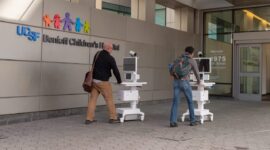 Telehealth transformation will still take years despite pandemic boom, says Amwell co-CEO
Telehealth company Amwell made its public market debut after months of rapid growth because of the covid pandemic. But the enormous digital transformation
Telehealth transformation will still take years despite pandemic boom, says Amwell co-CEO
Telehealth company Amwell made its public market debut after months of rapid growth because of the covid pandemic. But the enormous digital transformation
-
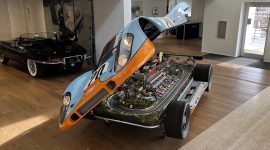 Experience your own 24 Hours of Le Mans with a Porsche 917 Slot Car
The Porsche 917 Slot Car is a miniature replica of the iconic race car that dominated the 24 Hours of Le Mans in
Experience your own 24 Hours of Le Mans with a Porsche 917 Slot Car
The Porsche 917 Slot Car is a miniature replica of the iconic race car that dominated the 24 Hours of Le Mans in

